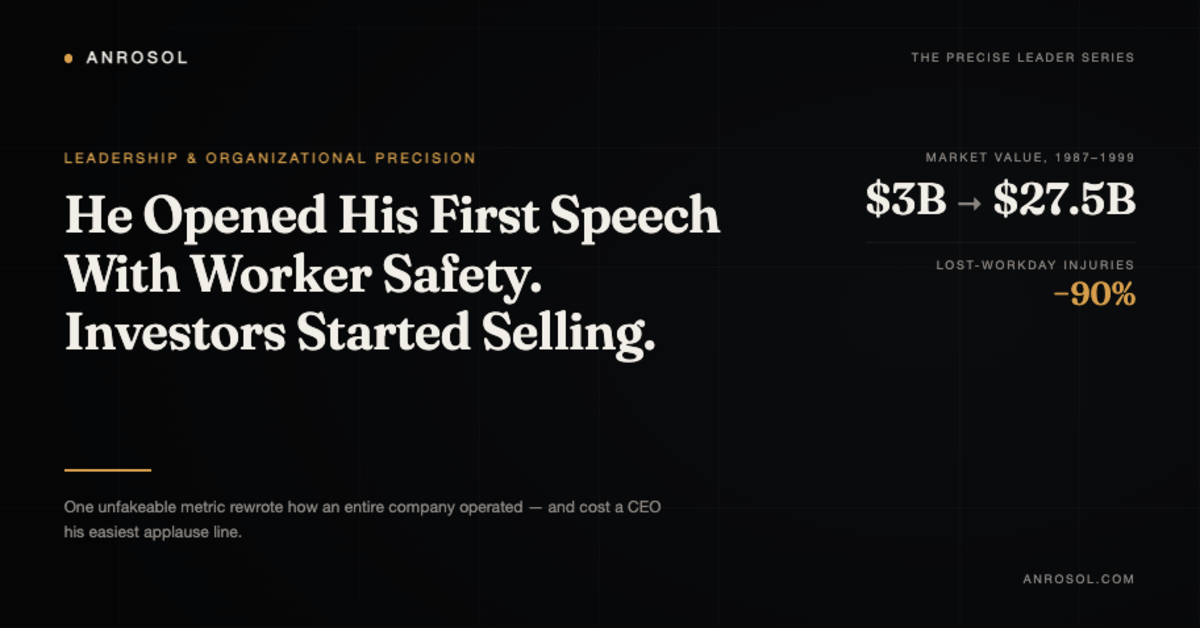
He Opened His First Speech With Worker Safety. Investors Started Selling.
The Precise Leader Series: Leadership & Organizational Precision
In October 1987, Paul O'Neill stood in front of Alcoa's shareholders for the first time as CEO.
The room expected what every room like it expects from a new chief executive of a struggling industrial giant: a plan for costs, margins, and market share.
He gave them one metric instead.
O'Neill told the room he intended to bring Alcoa's injury rate to zero, and that safety, not the usual financial ratios, was how he wanted to be judged.
No hedging.
No mention of shareholder value.
Analysts pressed him back toward inventories and capital ratios.
He didn't move.
Several investors left the room and called in sell orders before the meeting ended.
By the time O'Neill retired in 1999, Alcoa's market value had grown from $3 billion to $27.5 billion, and its lost-workday injury rate had fallen by roughly 90%.
The sell orders, it turned out, were the mistake.
Why the room got it wrong
O'Neill arrived at Alcoa from a career in public administration, not metals.
He was an outsider running a 100-year-old company losing ground to competitors, and the conventional read was that he'd fumbled his opening, that he simply didn't know what a CEO was supposed to say.
The conventional read missed the mechanism entirely.
Every financial metric a CEO can name from a podium, margins, inventory turns, capital ratios, shares one property: people inside the organization can quietly manage it.
Numbers get smoothed.
Timing gets shifted.
A scorecard becomes a performance.
I've spent 27 years inside technology organizations, first as a practitioner and now working privately with every leader in a company at once, CEO to front line, simultaneously.
From that vantage point, I can tell you how common the "managed number" is.
In nearly every organization I've worked with, there is at least one metric the board believes is a health indicator and the people downstream treat as a target to be hit by any available means.
The board deck stays green.
The underlying reality drifts.
Safety is different.
An injury either happened or it didn't.
There is no version of a worker in the hospital that can be reframed as a win.
O'Neill had chosen the one number in the company that everyone, at every level, had to tell the truth about.
That's the distinction that matters: precision over performance.
A leading indicator that can't be spun, versus a scorecard people learn to manage.
The first test: owning a death he didn't cause
About six months into O'Neill's tenure, a young employee at an Arizona plant died.
He had climbed past a safety barrier to clear a jammed machine arm, and the arm swung back and struck him.
He'd taken the job weeks earlier, for the health coverage, with a baby on the way.
O'Neill flew in and opened the meeting with the plant's executives with four words:
"We killed this man."
He didn't call it an accident, and he didn't stop the accountability at the plant floor, where it would have been easy, and defensible, to leave it.
He told the assembled executives it was his failure of leadership, and theirs too, all the way up the chain of command.
Then the group went through every point where the system had failed the man, one by one.
Notice what this does.
When the most senior person in the room takes the largest share of the blame, it becomes structurally safe for everyone below him to examine the failure honestly.
Nobody has to protect themselves before they can learn.
This is not a historical curiosity.
It's a live pattern in my work.
When something breaks in an organization, the first thing I watch in the leadership team is the direction blame travels.
In teams where it travels downward by default, the post-mortem produces a scapegoat.
In teams where the senior person claims their share first, O'Neill's move, the post-mortem produces information.
The second kind of team gets measurably better over time.
The first kind repeats itself.
The second test: firing a man whose fix worked
The counterpart came later, and it's the half of the story most retellings skip.
A plant in Ciudad Acuña, Mexico had a chemical leak.
About 150 workers were treated.
No one died.
The executive in charge installed a fix, a competent, effective fix, and then never reported the incident.
O'Neill only learned about it because a nun who had bought Alcoa stock raised it at a shareholder meeting.
O'Neill fired him.
His reasoning:
"He got fired because he didn't report it, so no one else had the chance to learn from it."
Hold the two cases side by side.
One man was held accountable for a death he didn't cause with his own hands.
Another was fired for something that hurt no one, except the organization's ability to learn.
Same standard, applied in both directions: own what happens on your watch, and never hide what happened on it.
Most leadership teams enforce one half of that standard.
Accountability flows downward easily; transparency about failure rarely flows upward at all.
In the one-on-one sessions I run across a leadership team, I routinely hear about problems at one level that the level above has never been told exist, not out of malice, but because the incentive to quietly fix-and-forget is exactly the incentive O'Neill fired a man over.
Accountability without transparency produces cover-ups.
Transparency without accountability produces excuses.
O'Neill's insight was that the two halves only work together.
What the metric actually did
Here's the part that turned one safety commitment into a $27.5 billion outcome.
To pursue zero injuries, Alcoa had to understand why injuries happened.
That meant frontline workers reporting problems upward without fear, plant managers responding within 24 hours, and executives redesigning processes that had been broken for decades.
The habits required to make safety real, fast information flow, honest reporting, systematic root-cause analysis, were the same habits that make everything else in a company run better.
Quality improved.
Downtime fell.
Costs came down.
Not because O'Neill chased them, but because the discipline built around one unfakeable metric spread into how the entire company operated.
That's the lesson worth carrying out of the story.
The value of a metric isn't just in what it measures.
It's in what the pursuit of it forces your organization to become.
The question for your own scorecard
The uncomfortable exercise O'Neill's story invites is simple: look at your own scorecard and ask which numbers can't be spun.
If the honest answer is "none of them," you don't have a measurement system.
You have a performance.
In practice, here is a test I sometimes give leaders that I work with.
Pick any number in your board deck and ask: if this number were quietly getting worse, who in my organization would be the first to know, and what would it cost them to tell me? If the answer to the second half is anything other than "nothing," the number is already being managed.
You already know which of your numbers can be quietly managed.
That's the one worth questioning.
Frequently asked questions
Did Paul O'Neill's safety focus actually cause Alcoa's financial results? Correlation and causation are fair to separate here.
What's documented is the mechanism: pursuing zero injuries forced faster reporting, honest escalation, and systematic process redesign, and those operational habits compounded across the business.
The financial results followed the operational change, not the slogan.
Does this only apply to industrial companies? No.
The underlying principle, anchor your organization on a metric that can't be gamed, applies anywhere a scorecard exists.
In software companies, the equivalents are usually things like unplanned incident counts or customer-reported defects: events that either happened or didn't.
What's the fastest way to find your "managed" metrics? Watch for numbers that never surprise you.
A metric that has looked healthy for eight consecutive quarters while people quietly complain about the thing it measures is almost certainly being managed somewhere below you.