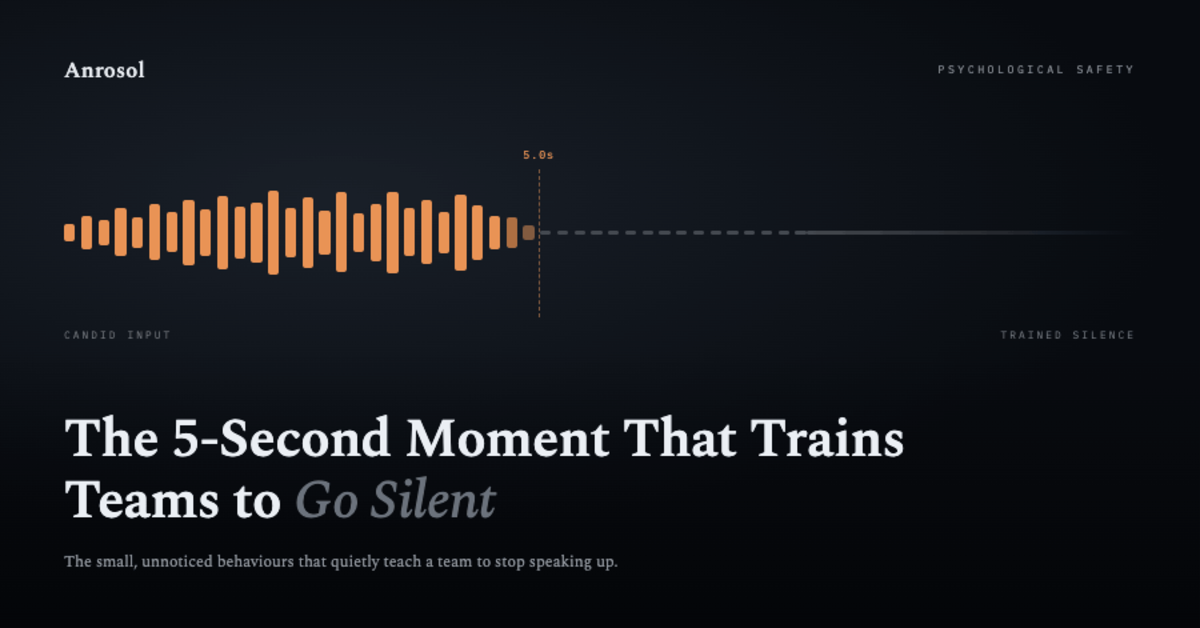
The 5-Second Moment That Trains Teams to Go Silent
The Precise Leader Series: Leadership & Psychological Safety
Amy Edmondson spent two decades at Harvard Business School studying why some teams speak up and others don't.
What she found wasn't what most leaders expect.
It wasn't culture.
It wasn't hiring.
It wasn't team structure or communication training or values written on a wall.
It was something managers do in everyday moments, often without noticing, that either builds or destroys a team's willingness to be honest.
What the Research Actually Found
Edmondson's work on psychological safety identified a consistent pattern among the leaders whose teams stayed vocal and engaged: they created space before they filled it.
They asked questions before offering answers.
They paused before reacting.
They let discomfort sit in the room long enough for someone else to name it.
This sounds simple.
In practice, it runs directly against how most managers were trained.
The instinct to project confidence, move things forward, and never leave silence in the room is not a character flaw, it's what organizations have rewarded for decades.
The problem is that those same instincts, applied in the wrong moments, train teams to stop thinking out loud.
The Moments That Do the Damage
Edmondson's research points to a specific category of managerial behaviour that consistently suppresses team candour.
None of it is dramatic.
All of it is common:
Jumping to a solution before the problem is fully named.
Filling every silence before someone else can.
A visible reaction, a frown, a shift in posture, to unexpected news.
Answering before a question is finished.
Each of these is a five-second moment.
And the team notices every one of them.
What the team observes, they internalize as a signal about what's safe to bring next time.
Over weeks and months, those signals accumulate into a team norm, one that either expands or contracts the range of what people feel they can say out loud.
This is how psychological safety is built.
And it's how it's destroyed.
Not in culture initiatives or offsite workshops.
In five-second moments, repeated daily, across every conversation a leader has.
What I See With Leadership Teams
In working with leaders inside technology organizations, the pattern Edmondson describes is one of the most consistent things I observe.
Leaders who pause, who ask a question rather than fill the silence, who let a team member finish a half-formed thought before responding, consistently get richer, more accurate information from their teams than leaders who don't.
Not because their teams are smarter or more experienced.
Because their teams have learned it's safe to think out loud in front of them.
The leaders who talk the most in their own meetings are often the ones sitting on the least accurate picture of what's actually happening in their organization.
The connection is direct: the more a leader fills the space, the less their team learns to occupy it.
This is rarely intentional.
Most of the leaders I work with are genuinely surprised when they see the pattern named.
The habit of having answers, of being the person in the room who knows, is deeply ingrained.
What takes deliberate work is replacing it with the habit of creating space for someone else to get there first.
The Shift: Precision Over Passivity
It's not about being slower or less decisive.
It's about being more intentional in the moments that shape how safe your team feels to bring you real information.
In practice, it looks like this: a team member brings a half-formed idea.
The old instinct is to redirect it, improve it, finish the thought.
The more precise move is to ask one question and let them get there.
The idea itself matters less than what the team member learns from that exchange, about whether it's safe to bring the next one, and the one after that.
Psychological safety, as Edmondson puts it, is not about being nice.
It's about creating a climate where candour is possible.
That climate is not declared.
It's demonstrated, in real time, in the small behavioural choices a leader makes every day.
Why This Is a Leadership Skill, Not a Personality Trait
One of the most important things Edmondson's research clarifies is that psychological safety is not a function of how warm or personable a leader is.
Some of the most approachable-seeming leaders run teams where people have quietly learned to say very little of substance.
What matters is behavioural consistency, the reliable pattern of how a leader responds when someone brings them something uncertain, incomplete, or unwelcome.
Leaders who respond to those moments with calm, curiosity, and genuine engagement, even when the news is inconvenient, train their teams over time to keep bringing things.
Leaders who react visibly, redirect too quickly, or signal impatience in the small moments train their teams, just as reliably, to filter first and share less.
This is a learnable skill.
It requires self-awareness, some discomfort, and sustained practice, but it's not a fixed trait.
Leaders who develop it consistently report that they start hearing things they hadn't been hearing before.
Problems surface earlier.
Ideas come forward that would previously have stayed private.
That shift doesn't happen because the team changed.
It happens because the leader did.
The Practical Question
If you want to know how psychologically safe your team actually feels, don't ask them directly.
Watch what happens in the room when something goes wrong, or when someone has a half-formed idea that might not land.
Watch how long it takes someone other than you to speak.
Watch whether people look at you before they finish their thought.
Watch whether the conversation in the meeting matches what you hear in the hallway afterward.
Those five-second moments are already happening.
The question is whether you're using them deliberately.